Wednesday, February 18, 2009

They certainly don't make them like they used to...

I've been lax with the posting as of late. RC Hacks will continue eventually. In the meantime I've been playing as much as I possibly can, and the good news is it's mostly Classic.

One of my co-workers found out that I play Dungeons & Dragons. She also played quite a bit of OD&D and 1st Edition in the mid-to-late seventies.

She brought in all the miniatures that she still has, most of which she painstakingly painted and kindly let me photograph for posterity.

If you can identify any of the figures, please don't hesitate to comment. Wherever possible I have included any intelligible markings I found on the bases.

For Scale is an old Quadrille Pad (6 squares per inch).


Enjoy! The Slideshow skips some Amazon warriors that were marked moderately/potentially risqué.

Tuesday, July 1, 2008

RC Hacks and House Rules: Page 226 - More Treasure!

The next random number takes us to page 226, still within Chapter 16: Treasure.

A couple of Treasure related charts here, but the one that really stands out as potentially much more useful than it initially presents itself is the Average Treasure Values Table.

Here we have a breakdown of Treasure types A-M (Lair only) by their average values in gold pieces. When I was younger, I always had an absolute blast generating treasure using the charts on the previous page. Having never owned the Monster & Treasure Assortment accessories, I instead made my own.

Classic D&D Hack:
I had a small container of index cards with alphabetic dividers A-V, with a dozen or so pre-generated treasure hoards waiting between each letter. I was always fairly meticulous about designing my treasures for adventures, but having a bunch of “DM Approved” hoards to hand out at a moments notice, definitely saved some time when players decided to sidetrack-down the lair of a Random Wilderness Encounter.

In the top right corner of each of these cards, I scrawled the overall gold piece value for the treasure for Experience purposes, but never in my many years of Classic did I ever bother to consult this Average Treasure Values Table to see how “close” I was with the average.

My first thought after studying this table was somewhat akin to a mental forehead slap. While the hours I spent throwing down percentile dice on the preceding charts were definitely fun, I could cut out some serious prep time by simply building this kind of Random Encounter coin out of these averages1.

Let’s take the Medusa: Lair Treasure Type F

The average value of this treasure in gold pieces is 7,600. Although the coins indicated in the treasure table for lairs are in the thousands, we can break this down any way we wish:

200 platinum
2,000 gold
4,000 electrum
5,000 silver
10,000 copper

But wait! Sharp eyes may have noticed my math is missing a thousand gold. That’s where a quick d1000 comes in handy. I rolled a 464, which gives me some more gold to play with and “uneven” the numbers of the smaller coins. The remaining 536 will even out the gold and above. This option is great for sticklers that prefer organic hoards that are random down to the last copper piece. Since the denominations of coins are mostly metric, this adjustment process is pretty quick. Just watch out for that pesky electrum.

Another way this table comes in handy is when planning character advancement. The Medusae in my Rules Cyclopedia are only worth a paltry 175 experience points apiece. But add in the average treasure value of 7,600 gold pieces and now we’re talking some actual advancement for low to mid-level parties. Most DMs prefer to intuitively adjust treasure and experience awards on the fly, but this table could serve as fairly useful guides for beginners who are trying to design by-the-book adventures with character advancement in mind. Locate the Treasure type that is most inline with how many experience points you would like a given adventure to reward (remember to divide it by the party), then simply locate a monster that has that treasure type. This sort of backwards design seems rather strange to me, but I could see it being useful.

Also on this page we have a few more tables pertaining to another type of treasure. Any Dungeon Master worth his or her salt can look at the following list of words and be relatively comfortable with them:
Agate
Garnet
Topaz
Carbuncle
Jacinth
Onyx
Peridot


The DM wears many hats: actor, storyteller, puzzle-designer, world builder, and yes, even amateur gemologist. Although I prefer to encrust my gems on large, unwieldy surfaces to encourage time-consuming prying (more Wandering Monster!), gems are still a staple of the fantasy treasure hoard. Getting to know your gemstones a little better is quite easy with access to the internet. Familiarizing yourself with a few more gemological terms and expressions as well as having some visual inspiration can really help make that dreadfully boring “500gp ruby” a thing of the past.

1. Since these averages do not include the value of magical items, and for magic items, the only pricing information in the Rules Cyclopedia pertains to creation (which is only a rough indicator of actual value). This means that the DM can’t easily just “buy” magical items to place in a hoard using the Average Treasure Table values. This is just as it should be, providing a few extra steps of deliberation before plunking down that Horn of Blasting.

Friday, June 27, 2008

RC Hacks and House Rules: Page 249 - Artifacts!

Flipping to the randomly generated page 249, here we have a sample Artifact: Mask of Bachraeus. Somewhat strangely, I haven’t been able to locate any additional information on Bachraeus in my Mystara material, and some digging around online seems to confirm that here, tucked in the Treasure chapter of the Rules Cyclopedia of all places, we’re given a new Immortal in the sphere of Entropy, from the flavor text, we can determine that Bachraeus is the patron of Medusae. Oh, the ideas...

I’m tempted to hook this into that bit at the end of B2 and turn the Keep into the first stop on an arching artifact-based adventure path. Who could forget that shapely prisoner imprisoned in the Caves of Chaos? With WoAdWriMo rapidly approaching, I'm being bombarded with ideas from every direction. Hopefully I can stick with one long enough to contribute this year.

As an aside: I’ve always had a soft spot for Medusae, but I definitely tend to portray them as much more classical, breathtakingly beautiful and sinister foes in my games. I really prefer this to the depiction they were given for 3rd (and carried over for 4th, unsurprisingly) edition.

Exhibit A: Bad Medusa.

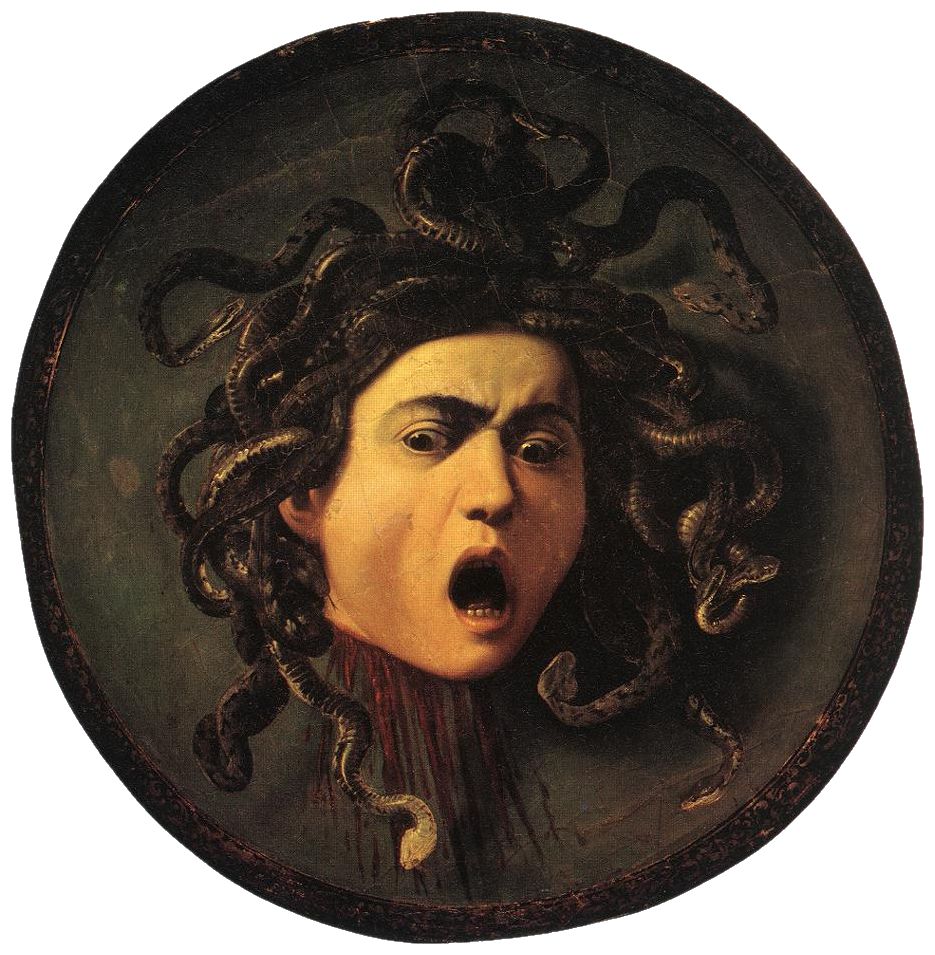
I like to go with the "cursed by the gods" for their beauty and hubris angle a little more I suppose. Here you have an amazingly gorgeous woman, and a mere glance at her will turn you to stone. Avoid the gaze, and you've still got the copperhead coiffure to contend with. Granted, it's really hard to argue with the awesome-ness of the serpentine Medusa from Clash of the Titans, and I also did enjoy Jeff’s Medusae (adapted from Marvel Comics), but when I think about Medusae, my brain instantly links to Caravaggio's depiction.

But back to our sheep, the system of Handicaps and Penalties outlined here is an interesting guideline, although I must confess, I'm pretty prone to shoving tiny magical quirks on virtually any magical item that my player's get their grubby hands on. This helps reinforce the idea that magic is unpredictable, and honestly, no two plus two swords should really be identical. The Handicaps associated with artifacts look pretty brutal, but the Penalty-per-use seems like a pretty way to balance an effectively limit-less spell casting item. I think in most cases, owning the artifact is enough of a problem as it is, and in the case of the Mask of Bachraeus, the players would probably have to contend with a rather perturbed nest of Medusae1, eager to get their precious artifact back.

ars ludi recently touched on making treasure special, and the artifact creation rules within the RC definitely seem to encourage this. By tying an epic history to an artifact, you can subtly encourage higher-level players to follow up on all those wonderful plot hooks and ideas that you've been itching to try out. In fact on the page there’s this lovely tidbit:
This artifact will shatter irrevocably if its gaze is ever reflected by the Golden Mirror of Ka. The wearer of the mask will be immediately stunned for a full turn and will remember nothing of what he did while wearing the mask, but he will be otherwise unharmed.
Aspiring DMs are given a springboard for the creation of their first artifact, within the description of the sample artifact! Golden Mirror of Ka you say? The one that was lost when Milenia was sacked and razed by the Bogdashkan Orcs?

Anyone care to take a crack at stat-ing the Golden Mirror of Ka in the comments? If you do, feel free to also provide a page number of the RC for me to tackle next!

1. Medusae need a collective noun. In searching for a suitably snake-y noun, I did come across a rhumba of rattlesnakes, which is great.

Wednesday, June 25, 2008

Mentzer Basic Set III

The Gygax Memorial transcript, continued from Part One Here and Part Two Here...

Wherein, our mighty adventurers agree to enter the Golden Gate and ascend several flights of stairs.

Magic-User: “About how long have we been climbing?”

DM: “As a Magic-User, you’re good with numbers and recognizing patterns, so I’ll say you’ve been counting steps this entire time. By now the party has almost twice as high as the previous set of stairs.”

Magic-User: “We must be getting closer to the surface! Maybe this is another way out!”

Fighter: “Using the 10 foot pole I’m going to prod along the steps ahead and make sure there aren’t any traps.”

DM: “So far so good, the steps finally end at a large 30 by 30 landing, there’s a rusty iron door barely hanging on its hinges in the center of the northern wall. The room is very dusty, and the rotting remains of a table and a few chairs are stacked in front of the door next to the short humanoid skeleton in corroded metal armor.”

Fighter: “30 by 30? Got it!”

Cleric: “Can I identify what race the skeleton is using my training as a Cleric of Lawful?”

DM: “It appears to be the skeleton of a Dwarf. Easily dead for a hundred years.”

Magic-User: “I’m going to try and search the room.”

Fighter: “Me too.”

Fighter: “And me! Watching out for traps.”

(rolls)

Fighter: “I got a one!”

(Still no wandering monsters)

DM: “Awesome Fighter! Beneath the skeletal hand of the dwarf you find a small piece of parchment, miraculously untouched by age and covered in thick silver runes.”

Fighter: “Magic-User! Magic-User! I think I found another Scroll!”

Magic-User: “I speak Dwarven, let me have a look at the runes.”

DM: “I’ll get back to you in just a moment Magic-User, Cleric what have you been doing all this time?”

Cleric: “While they’re searching the room, I’m going to say a prayer for the fallen Dwarf and take out the Wand that we found in the Kobold room. Is there anything on the wand that gives a hint about how it works or what it does?”

DM: “The wand appears to be made of finely carved ivory, potentially from the horn or tusk of some giant beast. It’s hollow and one end is decorated with a stylized eye carved out of a blue gem. Small shiny brass axes are inlaid on the “handle” and form the wand’s grip.”

Cleric: “Brass Axes. Like the Brazen-Axe clan? I bet this wand is dwarven.”

DM: “Magic-User, the runes on the parchment do not appear to be magical in nature, but it does contain a message. I can read it out loud and just assume that you’re translating it for everyone. OK?

Magic-User: “That’s fine.

DM: The parchment says: “Hid axe and wand where those barking buggers will never find ‘em. Groma if you find this, use the wand to find the supplies by Lawful, we’ll need ‘em against the mother. Gasses getting heavier. Seeping in. Forgefather protect us! I have failed you my King!”

Magic-User: “Bummer.”

Fighter: “I HAVE FOUND THE AXE! I guess that makes me smarter than the kobolds!”

Cleric: “And this wand is probably the wand in the message that we need to use to find the supplies. Magic-User can you tell me anything else about it.”

Magic-User: “I don’t know, can I?”

DM: “You can definitely tell that it is magical, probably not of an arcane nature though, and you know from your training that most wands need a command word to operate.”

Cleric: “What’s the Dwarven word for Lawful?”

Magic-User: “Dwawful

Cleric: “I hold the wand out and point it away from everyone and say “Dwawful” in a firm even voice.”

DM: “The tip of the wand glows brightly, illuminating the room in a pale blue light. The light seems concentrated on the flagstone beneath the dead dwarf.”

Fighter: “I MOVE THE DWARF!”

DM: “The blue light outlines the dusty flagstone.”

Cleric: “Awesome. Wand of Secret Door Detection or Find Traps. Be Careful!”

Fighter: “Using the 10 foot pole, I try to pry up the stone.”

DM: “It slides uneasily out of the way, revealing a dark opening.”

Magic-User: “I approach with my torch, what’s do we see.”

DM: “Your torchlight glimmers off of what appears to be a cache of fragile glass vials, filled with liquids.”

Fighter: “POTIONS! Magic-User!”

Magic-User: “I know. I’m on it. Do any of them look similar to the amber one that I gave to Fighter after his run in with the skeleton?”

Fighter: “ALAS HE HAD NO BLOOD TO SPILL, BUT I DESTROYED HIM AND AVENGED MY DEATH!”

DM: “Yes. Four of them appear to be remarkably similar to the amber potion. There are two more that are different though.”

Magic-User: “What color are they?”

DM: “Both are sort of a pale green color and slightly fizzy. Kind of like this...”

DM gestures to the Mountain Dew on the table.

Magic-User: “Mountain Dew? Seriously!?”

DM: “Ancient Dwarven Secret. Dew from the Mountains!”

Magic-User: “Is it Magical Dew?”

DM: “Could be. Who wants to test it?”

Fighter: “I HAVE ONLY 1 HIT POINT. STAND BY WITH AMBER POTION! I take a small sip of the Mountain Dew.”

DM: “Even though it is a small sip, you feel invigorated and full of vim and vigor…”

Fighter: “So it’s just plain Mountain Dew then?”

DM: “The ache in your muscles seems to vanish, Fighter, as do the circles under your eyes. The tiny cuts from your battle with the skeletons completely disappear.”

Cleric: “Looks like some kind of Super Healing Potion.”

Fighter: “Works like Mountain Dew!”

Magic-User: “We should definitely divvy these up. Everyone take an Amber Potion. Cleric and I will take a Mountain Dew a piece.”

DM: “I’ve created a monster… So what now?”

Fighter: “Is there anything else in the alcove?”

DM: “The potions appear to be resting on something metallic, but it’s difficult to identify with all the cobwebs.”

Fighter: “Magic-User, can I use your torch to burn away these webs?”

Magic-User: “Yes, but be careful. There may be scrolls in there.”

Fighter: “I carefully use the torch to clear away some of the webs in the hole, and use the extra light to get a better look at the metallic object.”

DM: “It appears to be a shield of some sort. There’s an inscription on it.”

Fighter: “OK, I’m going to reach in and pull out the shield. Can I read the inscription?”

DM: “It’s in Elven script but the words are Dwarven. Magic-User translates “To Groma, adventurer and ally to the end! I hope you return soon with help from your Elves!”

Cleric: “The concept of the relationship between the languages on this makes my brain hurt.”

Fighter: “I THINK I HAVE GROMA’S ARMOR IN MY PACK…”

Fighter: “I put on the Shield. How does it feel?”

DM: “Surprisingly light on your arm. You have a feeling that it may be magical.”

Fighter: “Magic-User? Oh, nevermind.”

Magic-User: “Yep. I can’t identify anything yet.”

Fighter: “Oh well, I’ll wear it.”

DM: “Great, there doesn’t appear to be anything else in the niche, and the room seems devoid of anything else interesting. What are you going to do, Caller?”

Magic-User: “If it’s cool with everyone, let’s get in order and try the door.”

Cools all the way around.

DM: “The door is very rusty and barely seems to be hanging in it’s frame. Who wants to open it?”

Fighter: “I WILL OPEN THE DOOR.”

DM: “Great! It swings open slowly into a well lit cavernous room. As your eyes adjust to the light, you notice that the floor of the cavern seems littered with thick Purple Fungus.”

Cleric: “Everybody stop! This could be bad news.”

DM: “In the distance you hear a low roar.”

Magic-User: “Is it like the roar before?”

DM: “Very similar.”

Magic-User: “Great. Everyone watch out, I think we just found a back door into the waterfall room. Here be dragon.”

Fighter: “I WILL SLAY HIM FOR THE GLORY OF THE BRAZEN AXE!”

Fighter: “I’m going to poke some of the fungus with the 10 foot pole.”

DM: “ The fungus exudes some sickly looking violet spores. I need a Save vs. Paralysis from everyone.”

Party: “Crap.”

(I hadn't actually planned to have the spores have a negative game affect, but what can I say, it’s always fun to see them squirm.)

Fighter: “I ROLLED A TWELVE.”

Magic-User: “Sixteen.”

Cleric: “18.”

Fighter: “It landed on a corner. But I think it’s supposed to be a fourteen.”

DM: “Awesome. Everyone manages to bring a free hand up to their faces quickly enough to prevent themselves from inhaling the strange purple spores. The cavernous room looms ahead full of stalactites and stalagmites.”

Magic-User: “Stalactites are on the ceiling. The C is for Ceiling. The G in Stalagmite is for ground.”

Cleric: “Do I recognize any of this fungus?”

DM: “You have a feeling that it might be useful somehow. Probably for the clearing the lungs. You’re not really sure.”

Cleric: “Don't spores usually do the opposite? Better not risk it. Is there a way to get across the room without disturbing the Lungus.”

DM: “It seems to clump around the bases of some of the larger Stalagmites. So it should be possible to navigate through it if you move slooowly.”

Magic-User: “Slooowly guys. Let’s go.”

Fighter: “How big is the room?”

DM: “Whoops. It’s large. Uneven. The ceiling is probably about thirty feet high, the room itself is a cavern, roughly a hundred feet wide. The Roaring sound comes from the north.”

Fighter: “I hate mapping caverns.”

Magic-User: “Waterfall is north. Everyone try to be extra quiet and careful. Last time we saw a waterfall, there was a dragon.”

Fighter: “A green horse dragon.”

DM: “A dragon as big as a warhorse. You creep slowly and carefully through the fields of fungus, drawing nearer to the roaring sound of the waterfall. Soon you reach a ledge that overlooks the dragon sleeping atop its hoard. The ledge is about 50 feet high. The roar of the waterfall means that there’s little chance that you’ll be overheard.”

Magic-User: “Alright guys, looks like we’re fighting this dragon whether we want to or not. We should probably get a strategy together…”


To be continued further...

Tuesday, June 24, 2008

Rules Cyclopedia Hacks and House Rules: Thief Special Abilities

Rules Cyclopedia: Chapter 2: The Character Classes, Page 22.

Oh, I was hoping I would have a few more of these under my belt before tackling this, but the random number generator has spoken. Page 22 consists mostly of tables relating to the Thief character class, specifically, the Experience Table, Saving Throws, and of course, the Thief Special Abilities Table.

Gentle reader, versed in the ways of Classic D&D, I’m sure you can sense the reasons for my trepidation here, for there are a few features of the Thief Special Abilities Table that seem somewhat out of place among an otherwise light rules set.

I’ve made several attempts over the years to find a solution for what I see as the key problems with this particular Table. Problems may be too strong a word, bugbear is better.

Ktrey's Key Bugbears:

  1. Percentile Based Resolution – Other than the Woodland Abilities of the Halfling, virtually none of the Special Abilities for other classes are tied to the success of a roll on a d%. I understand that the d% produces much more granulation than the other dice, but it still seems out of place for D&D PCs. After all, we’re not playing RuneQuest.

  2. Six of the Eight Thief abilities, when tested by player, can lead to awkward game-play situations.

    1st level Thief Player: “I check for Traps” (rolls 52%)
    DM: “You don’t find any.”
    (Player knows that he rolled above his Find Traps, so there could still be traps and perhaps proceeds a bit more cautiously. Quite a classic quandary.)

    1st level Thief Player: “I try to Move Silently” (rolls 45%) “Crap.”

    Before you cry “player problem,” please entertain the inconsistency here, although failure at a task should always be a possibility for players, only a few other classes have built in thresholds like this (the Cleric's Turning Chart comes to mind). Fighter can swing his sword against a foe and the outcome is unknown until it is compared to the AC of the defender (which the Fighter can guess, based on the foe's armor, etc, but this is not a sure-fire way to determine the difficulty). Magic-User's get their spells off, and the Saving Throw determines success or failure (what does an Owl Bear save as again?). Thieves are first hand witnesses to their failure, in real time.

    The previous page in the Rules Cyclopedia (p. 21) has some text that addresses this with the following:
    “at the DM's discretion, either the player or the DM will roll percentile dice (d%).”
    I tend to automatically dislike anything that takes the dice out of the player’s hand, doubly so when it is tied to their character’s success or failure at a task.

    The Rules Cyclopedia also continues by mentioning circumstantial bonuses and penalties that can be applied to the chances in order to further obfuscate potential success and failure. A rusty lock granting a 40% bonus to Open Locks, etc.

    With the addition of these two caveats, percentage based abilities work a little better, but still just don’t seem to fit in with the understated elegance of the rest of the rules.

  3. Poor 1st level Thieves begin play with the following percentages:
    Open Locks 15%
    Find Traps 10%
    Remove Traps 10%
    Climb Walls 87%
    Move Silently 20%
    Hide In Shadows 10%
    Pick Pockets 20%
    Hear Noise 30%
    These aren’t terrible odds on paper, with most of the abilities increasing by five each level for the first eight levels, but in actual play, lower level thieves simply can’t shine without hefty “circumstantial help” from the DM or incredibly consistent luck.
In the past, I’ve done some rather strange things to address these issues. Some proved more popular than others, and as with any of my Rules Cyclopedia House Rules, these can be taken, left, or adapted to fit. If anything I hope to promote more discussion about polishing an already shiny system that is perfectly playable as-is.

So without further ado, I present some Hacks and House Rules for Page 22 of the Rules Cyclopedia:

To address Key Bugbear 3 (Poor 1st Level Thieves) I’ve occassionally let players add ability score based amounts to their Thief Abilities:

Ability Option One: DEX x 5
This gives beginning thieves anywhere from 15 to 90 points to spread out among their Thief abilities. Allowing for a great deal of customization (to fit backstory, or character concept). To limit this somewhat, I recommend that players adhere to certain restrictions; no thief ability can be raised above what it would be for a 5th level thief, or no ability can receive more than 20 points this way. Like most Point-Buy additions, this option does result in more book-keeping, as players need to keep track of their bonus points and actual level percentage separately. In play, it also tends to make for some pretty darn competent thieves, which is generally only ideal for a short campaign.

This option is very hackable to boot. Consider trying DEX x 4, or 3, or 2, or even 1 depending on personal preference and the power-level you promote. It's just a little extra-oomph for the Thief who fancies themselves a master locksmith, but would never dream of picking a pocket.

Ability Option Two: Ability Based Bonuses.
This option ties different stats to the different thief abilities. Then, either the ability score, or more stingily, any ability score bonus is applied to the Thief Ability in question.
Open Locks - DEX
Find Traps - WIS
Remove Traps - INT
Climb Walls - STR
Move Silently - DEX
Hide In Shadows - DEX
Pick Pockets – DEX (Possibly CHR?)
Hear Noise – WIS
Dexterity is arguably one of the best of the six ability scores in Classic D&D, providing that much needed Armor Class boost at lower levels, as well as the bonus to hit with missile weapons. This option takes some of the bite and power out of the attribute, and may lead to more careful ability score selection.

While the above ideas primarily seem to address the power level of thieves, some of the options outlined below also work wonders for this. This section outlines some ideas for dealing with Key Bugbear #1: Those Pesky Percentages!

Pesky Percentages Option 1 or D6 Forever!
Some other intrepid House Rulers have worked to convert the Thief Abilities into tasks that can be resolved with a d6. Their rather impressive work on this subject can be found on this page: Thieves and Rakes: A Variety Of Class Options. While I haven’t had the chance to playtest these rules, they do seem to strike me as sound. And I especially like that the rules dovetail nicely with the extant “find secret doors” and “listen” rules for demihumans.

Pesky Percentages Option 2 or Task Difficulty as Armor Class
Give Thieves the Fighter’s Attack Progression for attempting their Thief Abilities, and give their obstacles an Armor Class based on difficulty. Decide whether or not you would like to allow Dexterity bonus (or even other ability bonuses) to figure into this roll. The Thief then simply writes a THAC0 next to each of his abilities and task resolution is handled with the roll of a d20 against the DM determined AC of the obstacle. As a handy hint, this Obstacle AC can decrease as the character descends deeper into a dungeon.

This Option also helps bring back some of that “mystery” to thief abilities, as the player will likely never know the difficulty of the obstacle they are trying to overcome, and therefore won’t automatically be tempted to assume failure or meta-game (see: Ktrey's Key Bugbear 2). Unless a One is rolled and there are provisions for automatic-failure. I have in mind an upcoming article on one of the more venerable (second perhaps only to the Critical Hit?) house rules: The Fumble. The “Joys of Fumbling” will provide some advice on how to handle these 1s.

Pesky Percentages Option 3 or Convert Thief Abilities to General Skills
Since Stealth (choose terrain) is already a General Skill, some Dungeon Masters may be tempted to simply convert the other thief abilities into Rules Cyclopedia General Skills. These General Skills can use Dexterity, or for more variety, the optional ability scores above. While this does mean that Thieves will start off with 8 more General Skills than the rest of the character classes, and may be spending all of their skill slots improving these abilities rather than taking on new General Skills, they are Thieves after all, and this is only a method of representing their specialized training and niche. For this very reason, limiting or disallowing other classes to take these skills is highly recommended to keep the Thief special. One could even give Thieves another “Thievery Skill Slot” every few levels (I’ve had success with adapting the Weapon Mastery table for this) to encourage them to use their normal slots to take other skills.

Caveat: With high ability scores the chance of success for thief abilities converted in this manner increases dramatically, so liberal application of those “circumstantial modifiers” might be needed. On the flip side, a set of +1 Lock Picks, or Boots of Silent Step +2, become wonderful treasures that fall in line with the Fighter's ubiquitous +1 Longsword. (Lock Picks +10%? Please.)

Or, if you prefer to not deal with the headaches of “circumstantial modifiers”, give each of the Thief General skills a flat base. Say, 8-10 (or cruelly roll randomly! Yikes!) and allow them to be improved normally with slots via advancement. With this method it might be better to use the “growing d6” method for resolution (helm tip to Sham’s Grog n’ Blog for highlighting this niftiness). Simple tasks are resolved using 2d6, standard tasks are resolved using 3d6, for more difficult tasks, increase the number of d6s and ring in the bell curve.

Pesky Percentages Option 4
Slot Based Thief Abilities or When Things Just Get Weird.
This one is rather radical, but was fairly fun for the players. Thieves use the Magic-User’s spell progression for their “Thief Slots.”

Glancing over the Spell Lists for the respective Spell Casting Classes, let’s look at some Thief Abilities and their Magical counterparts.
Find Traps – 2nd level Cleric Spell – Find Traps)
Open Locks – 2nd level Magic-User Spell – Knock)
Remove Traps – 3rd level Magic-User Spell - Dispel Magic?)
Move Silently – 2nd level Cleric Spell – Silence 15’ Radius)
Hide In Shadows – 1st level Magic-User Spell - Darkness, or 2nd level Invisibility)
Climb Walls – 2nd level Magic-User Spell – Levitate?)
Pick Pockets – 1st level Magic-User Spell – Charm Person?)
Hear Noise – 1st level Cleric Spell – Detect Evil?)
Some are less than perfect fits I agree, but bear with me. For the most part, Thieves will use the standard method in your game for Thief Special Ability resolution, but giving the Thief a limited number of Daily “auto-success” for their abilities could considerably improve their chances to shine.

Some interesting questions crop up: Do they meditate on any of these techniques every night and pick a new one from their “Thief Slot List” each day (like Clerics)? Do they begin with access to only one to study nightly, and then “learn” them from other, more experienced thieves or musty manuals of thievery (Magic-User)? Are there new and exciting Thief techniques that can be learned? Are the game mechanics of these “Thief Slots” identical to the spell effect (modified to have Magic read as Traps in the case of Dispel Magic)? These are some thought-provoking questions for the DM brave enough to attempt or adapt this hack, and are tragically beyond the scope of this installment.

At roughly the equivalent level for Clerics, and exactly for Magic-Users, the spell casting classes already have the ability to perform these tasks, edging in on the territory of the Thief while simultaneously tying up a precious spell slot. I find it helps to keep in mind that Thieves tend to advance much quicker than the other classes, but this advancement doesn’t really seem as rewarding as the others (and only produces a lot of erasures beneath their “Thief Abilities” section on their sheet).

What about the 7th level Thief and their first 4th level “Thief Slot” you ask? Well a quick glance at the spell lists reveals some potential candidates:
4th level: (Cleric Spell - Neutralize Poison (“I've spent years building up an immunity to Black Dougal’s Bane”)
For dastardly thieves, its reverse Poison could also be neat.
4th level: (Magic-User – Polymorph Self) Disguise anyone?
By turning creativity up, it becomes pretty difficult to place a limit on which spell effects Thieves could potentially replicate as one of their “Thief Slots.”

Be warned however, this option is straying very far out of the stalwart Keep of house-rule territory and closer to woolly woods and chaotic caves of “System Revision.” In fact, it seems that something very similar was tried previously with the old Warlock RPG as one of the first attempts to “fix” D&D:

Warlock RPG - Thief Special Ability Charts

Some good ideas here for “Thief Slots,” but again, this is dangerously close to rewriting the game. Using these, I’d be tempted to start writing up some “Fighter Slots” and then I might as well be fiddling with another Edition.

Which of these Hacks/House Rules do I use in my games? Well, currently I don’t have a Classic D&D game running (although I’m looking to rectify this soon), but one of my last games with Thieves used the Task Difficulty as Armor Class option with a surprising degree of success. Almost to the point of me adopting the progression across the board, with each class using the Fighter progression for various Class related tasks, but that, I’m afraid, will need to wait for another post...

Bah. Who am I kidding? For my next game, I'm just as likely to play completely by the book with my Thieves. The Rules Cyclopedia just plain rules, and the above could just be considered a lengthy thought exercise. But do let me know if you find anything interesting, useful, or unclear.

Dedicated to the memory of Luven Lightfinger, Apprentice extraordinaire (Str 13, Int 14, Wis 9, Con 12, Dex 16, Cha 13) who lost his life “In Search of the Unknown” along with his party’s Elf due to rolling poorly versus a portcullis trap:

If all attempts to escape fail, the persons trapped will be doomed to their fate.

Thank you Mr. Carr and B1.

Monday, June 23, 2008

The House Rules Cyclopedia (Part One)

This will be the first of my (weekly? Bi-weekly?) installments regarding the wonderful Rules Cyclopedia. Some entries will focus on House Rules, and others will revolve around some of the RC hacks I’ve used in the past.

Not including the Appendices and Contents/Credits sections, the Rules Cyclopedia contains around 263 pages. But, instead of wading through in order, I’m going to be using this Handy Custom Random Number Generator to generate a page number between 5 and 267. This will let me tackle the contents of the book rather haphazardly, and I embraced randomness long ago. Besides, I’m firmly convinced that a potential Hack or House Rule lurks on virtually every page of this book.

First result: Page 98. (Any readers should feel free to follow along at home)

Here, tucked away in Chapter 7: Encounters and Evasion we have a rather remarkable table (Subtable: 11. City Encounters). By combining the roll of a d8 with a d20, any of 160 people and professions are at your disposal to give that “Human” result from the previous tables a little more punch. Or one could use it to add a little more spice to the randomly encountered city denizen.

However, I have a feeling that this table is eminently more hack-able.

I'll be using this nifty online dice tool to help me take this table through the paces, and Yafnag is great for the occasional random name.

Subtable: 11. City Encounters (Page 98) Hacks:

Random Character Backstory:
These days, characters are rarely born in a vacuum, and some players just love fleshing out their character’s history and backstory for you. But this table can be used to give others a springboard, and the results can provide some excellent adventure seeds as well.

Example:
So, father was a Gambler (4.4) and your brother is a respectable Wheelwright (8.17). If father’s still alive, maybe he owes money to a (7.17) Tavernkeeper. Maybe your sister ran off with a (4.12) Guardsman. Childhood sweetheart: son of a (4.11) Graveyard Keeper. Best Friend: (7.5) Indentured Servant.

Even More Backstory?
What did your character do before becoming an adventurer?

Example:
Maybe you aspired to be a (8.10) Vigilante.
Interesting.
Who committed the crime? (4.5) A Gemcutter. Against who? (3.10) A Druid Adventurer.

Contacts
Continuing the theme of living, breathing characters, I’ve always been tempted to use this table to help tie players to a particular place by letting them begin the game with a few “friends.” Sometimes a character’s contacts can also be brimming with interesting story, hooks, and/or seeds.

I smell a House Rule:

HOUSE RULE:
Characters start the game with d4+Charaisma Bonus Contacts. Either randomly roll (my personal favorite) or choose some “contacts” from Subtable: 11. City Encounters. These “contacts” are people that your character knows and who are automatically considered “friendly” for the purposes of NPC Reactions. Remember that Armorsmith in the sample adventure from the Mentzer Basic Player’s Handbook who let your character trade his chain for plate? These NPCs are people have known your character long enough to do you the odd favor or two, and likewise if they needed help from you, you’d be hard pressed to refuse.

Example:
Artan the Fighter has 3 Contacts:
(1.16) Bazaar Merchant
(4.1) Freighter
(2.12) Carter
Need to stowaway somewhere? Looking for rare goods? Need help smuggling something through the city? There you go. Randomness sometimes produces results that go together like peas in a pod. This is one of those examples. Looks like Artan might have been a Caravan Guard or a Marine/Sailor at some point.

General Skills
Do you use General Skills? Need something for those pesky Profession (choose type) and Craft (choose type) skills?

Example:
How about Craft (4.8 – Glassblower) or Profession (8.20 – Woodcutter)? This table can really help characters fill in some blanks.

Retainers, Hirelings, Henchmen
Who doesn’t like Retainers (or Hirelings, or Henchmen)? Chapter 12: Strongholds and Dominions specifically refers to this table on page 138 in regards to retainers. The RC seems to have phased out the use of the term Hirelings (although the Retainers section does state that the two are interchangeable).

Example:
Hirelings weren’t always necessarily mercenaries for hire, why the extra sword-arm and treasure-porter you managed to hire might actually be a former (4.10) Government Official. Better yet, what if she still is?

Adventures
I’ve even used Subtable: 11 City Encounters in the past as a springboard for urban adventure.

Example:
First I use the table to make a few NPCs
(8.14) Winemaker
(5.1) Jailor
(6.11) Politician
(1.8) Astrologer

Then I embrace randomness, and try to string them together:
A superstitious Politician needs the adventurers help to get information from a local Winemaker about an alcoholic Jailor that he suspects of being susceptible to bribes. Along the way, the PCs will need to solicit the help of a greedy Astrologer.

Heck. Even a dungeon hook one-liner can work sometimes:
Go to the dungeon and rescue a prominent (5.14) Madame from the clutches of the goblins that waylaid her carriage as she was traveling between cities.

Urban Design/World Building
So you’ve mapped out that city/village/hamlet but what are all those buildings? How does this town relate to others economically?

Example:
Well, the small rectangular building belongs to a (8.4) Town Hall Employee, who also works as the town’s (7.14) Weaver. Another quick roll and (7.1 – School Teacher) tells us that that the building by the river is a School, while (4.19 - Hunter) can be interpreted to tell us that this town’s chief export might just be furs and skins. The (6.19) Taxidermist will tell you that most of the town’s imports consist of (3.4 – Diary Worker) dairy goods from another nearby village.

When coupled with a little bit of creativity, this table is positively brimming with ideas and has many more uses than just your standard “Encounter Table.”

Have you ever found a use for it in another interesting way?

Friday, June 20, 2008

My girlfriend is incredibly interesting.

So I was blathering on and on about how much I enjoy the combat mechanics of The Riddle Of Steel today as my girlfriend Candace was practicing on her ukulele when she provided a pretty nifty 4e House Rule.

See, she was thinking a little bit more about the 4e Combat System of Powers and their usage constraints. We played a really sloppy and quick combat session on Tuesday with the usual group and sure enough, Candace the RPG Combat HaterTM actually enjoyed what her Tiefling Wizard could do to control the battlefield.

Without further ado, I present a paraphrasing of her neat idea:

"I was thinking about the powers in 4e combat. You get your at-will, your encounter, and your daily powers, but what about a per-level power. An awesome, sort of David vs. Goliath thing for Clerics for instance."

Wow that sounds all kinds of cool. The economy of action in 4e virtually guarantees that players will be siphoning off their Encounter Powers toward the end of the battle, or their Dailies if an Extended Rest is eminent. But players only really have a rough idea of when they are actually going to level, so this might be something special that they want to hold on to "Just In Case."

I'm personally thinking about allowing this "Level" power to be chosen from the next level of Powers (daily, encounter, at-will, whatever is applicable to the situation). As a bonus it'll also help players get familiar with what they have to look forward to next level.

I've been blogging a bit 4e-centric lately, but don't worry, I haven't drank the flavor-aid just yet. I'll be returning to form very soon with a weekly "Rules Cyclopedia House Rules" column.

Search

Root Ring!

Labels

random tables (317) d100 (314) tables (163) encounters (142) OSE Encounters (133) OSE (132) magic items (44) dungeons (25) equipment (20) magical items (20) monsters (20) wilderness (19) wilderness tier (19) character generation (17) dnd (17) magic (16) treasure (16) spells (15) clerics (14) rumors (14) NPCs (13) gear (12) generators (12) hexes (12) hex crawls (11) house rules (11) spell features (11) BECMI (9) ideas (9) names (9) RC hacks and house rules (8) advancement (8) dressing (8) plants (8) resources (8) characters (7) curses (7) dnd hacks (7) events (7) magic users (7) settlements (7) stocking (7) adventure hooks (6) animals (6) cities (6) clues (6) dolmenwood (6) dungeon stocking (6) treasures (6) weapons (6) why tables (6) backgrounds (5) classes (5) domain tier (5) fairy tales (5) potions (5) religion (5) set dressing (5) shrines (5) what tables (5) world building (5) yoon-suin (5) character sheets (4) current campaign (4) doors (4) dragons (4) fair folk (4) food (4) foreground growth (4) hirelings (4) hooks (4) jewelry (4) mountains (4) reviews (4) team tuesday (4) tools (4) villages (4) 4e (3) Elfs (3) PCs (3) TROIKA! (3) WHITEHACK (3) abilities (3) armor (3) cantrips (3) carousing (3) character classes (3) clothing (3) decoration (3) dm (3) domain (3) downtime (3) dungeon dressing (3) foraging (3) fourth edition (3) fungi (3) goblin project (3) how tables (3) landmarks (3) locks (3) maps (3) mentzer (3) mushrooms (3) overland (3) procedures (3) puzzles (3) questions (3) quests (3) religions (3) rules cyclopedia (3) spellbooks (3) swords (3) tells (3) traits (3) transcripts (3) traps (3) vignettes (3) where tables (3) wizards (3) Cairn (2) Dwarfs (2) ability scores (2) abstract combat (2) adventures (2) backstories (2) books (2) bows (2) buildings (2) castles (2) character death (2) city crawls (2) community projects (2) consumables (2) d&d (2) death (2) deities (2) deity disfavor (2) drinks (2) experience (2) factions (2) fairy tale friday (2) fauna (2) fighters (2) flaws (2) flora (2) folklore (2) followers (2) forests (2) furniture (2) gods (2) gorgon trail (2) habits (2) harry clarke (2) hazard system (2) herbs (2) hex crawling (2) hex stocking (2) hex-describe (2) hobbies (2) identification (2) identifying (2) journeys (2) knacks (2) lairs (2) lore (2) magic systems (2) magic-users (2) magical research (2) meetings (2) miens (2) money (2) omens (2) portals (2) projects (2) reaction rolls (2) reagents (2) retainers (2) rituals (2) rooms (2) sailing (2) saving throws (2) scrolls (2) sea (2) secret doors (2) shields (2) ships (2) single-use items (2) skills (2) smells (2) special abilities (2) spoor (2) staffs (2) stocking tables (2) strongholds (2) superstitions (2) tex-crawl (2) thieves (2) toadstools (2) traces (2) tracks (2) wave crawls (2) wonders (2) words (2) 20 minute dungeons (1) 5e (1) DR (1) GLOG (1) KtA (1) NPC Party (1) OSR (1) Rival Adventuring Parties (1) VEINS (1) aasimar (1) absent players (1) accessories (1) activities (1) adventure seeds (1) adventurers (1) alcohol (1) alignment languages (1) altars (1) ammo (1) ammunition (1) angels (1) arduin (1) arrows (1) art (1) artifacts (1) axes (1) backpacks (1) bags (1) balms (1) bards (1) beans (1) belts (1) berries (1) birds (1) blessings (1) blogging (1) blogosphere (1) body art (1) bookshelves (1) boons (1) boots (1) bounties (1) bracelets (1) bracers (1) breath weapons (1) brooks (1) businesses (1) calendars (1) campaign starters (1) camping (1) candace (1) candles (1) cards (1) cartography (1) celestials (1) ceremonies (1) clergy (1) cloaks (1) clubs (1) coins (1) cold iron (1) collective nouns (1) combat (1) commodities (1) common (1) commune (1) complications (1) connections (1) containers (1) corridors (1) cosmology (1) couplets (1) creeks (1) critters (1) crossbows (1) crowdsourcing (1) customs (1) d12 (1) d36 (1) d66 (1) dances (1) debts (1) deception (1) deeds (1) defenses (1) dilemmas (1) dimensions (1) discoveries (1) diseases (1) divination (1) divine (1) dogs (1) donkeys (1) downloads (1) drawbacks (1) encounter activities (1) encumbrance (1) energy drain (1) excuses (1) exploration (1) fairies (1) fairy (1) familiars (1) features (1) festivals (1) fey (1) finances (1) fish (1) fishing (1) flow charts (1) foibles (1) foodways (1) fountains (1) friendly monsters (1) fruits (1) future campaigns (1) galmours (1) game jams (1) gardens of ynn (1) garlic (1) garments (1) gary gygax (1) gauntlets (1) gems (1) geography (1) girdles (1) gloves (1) grimoires (1) groups (1) gullets (1) hacks (1) hallways (1) hats (1) hazards (1) healing (1) helmets (1) hex features (1) hex-crawling (1) hexagons (1) hiding (1) hints (1) history (1) holiday (1) holidays (1) horses (1) humanoids (1) hunting (1) illusions (1) in medias res (1) incense (1) ingredients (1) initiative (1) insects (1) itch.io (1) keep 'em poor (1) keys (1) lamp oil (1) lamps (1) landforms (1) languages (1) lanterns (1) legends (1) light (1) limited-use items (1) lists (1) locations (1) lockpicks (1) maces (1) magic research (1) magic words (1) mapping (1) masks (1) meanwhiles (1) memes (1) mentors (1) mercenaries (1) merchants (1) miniatures (1) misfortunes (1) mishaps (1) modern (1) monster motivations (1) motivations (1) mules (1) mutations (1) mysteries (1) nautical (1) new spells (1) nouns (1) obituaries (1) objects d'art (1) ocean (1) oceans (1) ointments (1) overland exploration (1) overland travel (1) overloaded encounter die (1) pastimes (1) percepts (1) perchance (1) perdition (1) pets (1) pits (1) places (1) planes (1) player characters (1) poisons (1) pools (1) pouches (1) pranks (1) predicaments (1) priests (1) procedural flow charts (1) process (1) props (1) protection scrolls (1) provisions (1) purses (1) quarrels (1) raise dead (1) rations (1) reasons (1) referee aids (1) relics (1) reputation (1) restocking (1) rests (1) resurrection (1) rewards (1) rings (1) rivers (1) roads (1) robes (1) rolemaster (1) ropes (1) rules (1) ruminations (1) saints (1) salves (1) sashes (1) scenery (1) scheduling (1) sea faring (1) seafaring (1) seafood (1) secrets (1) senses (1) sentient swords (1) session starters (1) setting questions (1) settings (1) shoes (1) shopping (1) side effects (1) side-effects (1) site features (1) sites (1) so tables (1) software (1) soirées (1) song tables (1) songs (1) sounds (1) speak with animals (1) speak with dead (1) speak with plants (1) spears (1) special attacks (1) special results (1) specials (1) spell casting (1) springs (1) statues (1) stomachs (1) stories (1) streams (1) streets (1) strict time keeping (1) subsystems (1) surprise (1) swanson abilities (1) swansong abilities (1) table talk (1) task resolution (1) tattoos (1) taverns (1) tea (1) telepathy (1) terrain (1) the middle road (1) thief (1) thieves cant (1) tieflings (1) timekeeping (1) tinkering (1) tomes (1) toys (1) trade goods (1) traders (1) travel (1) treasure maps (1) trees (1) trinkets (1) turn undead (1) urban crawls (1) value (1) venoms (1) vermin (1) voronoi (1) wands (1) waterskins (1) weather (1) whence tables (1) wildlife (1) word games (1) xp (1) ynn (1)

Blog Archive