- Race (Elf, Dwarf, Halfling) as a class? Yes or no? I prefer Race as Class to differentiate demi-humans from Humans. Most of the class features/abilities of the four Human classes are not culturally relevant to the demi-human races (no concept of religion for Elfs, taboos on Magic for Dwarfs, I don't normally use Halflings), demi-humans also have a different alignment axis than Humans (instead of the standard Neutral, Lawful, Chaotic). Class merely defines initial character capability though, so it is still possible to subvert these arch-types through character development in play.
- Do demi-humans have souls? Sort of. Elfs are human babies stolen and raised in the Elflands, usually their soul is owned by another Elf. If they manage to get it back and spend too long away from the Elflands, then they can potentially become Human again. If they stay Elf, as they grow older in seasons or more experienced they sometimes go through the metamorphic process that begets Dwarfs. The question seems to be geared more to whether or not they can be raised from the dead. I don't typically include Raise Dead/Resurrection magics in my Classic D&D games, so that aspect doesn't really apply.
- Ascending or descending armor class? I prefer Descending Armor Class (9 to 2), but can cope with Ascending as long as there isn't too much bonus inflation. My players typically prefer Ascending. We sometimes compromise with TARGET 20.
- Demi-human level limits? Traditionally yes, but I don't think I've ever had a demi-human player in a game that reached them. They are important for determining at what point an Elf character might start transforming into a Dwarf, and start over with a new Class progression.
- Should thief be a class? It's available to Human characters in most of my games, I sometimes rename or remove it for cosmetic reasons (Clerics are also victims of this). Thief Abilities are treated as Saving Throws.
- Do characters get non-weapon skills? A character's background might grant them some professional abilities to differentiate them from other members of the same Class. Characters can learn useful and marketable skills through play. Skills are only adjudicated through die rolls if there's a potential for failure and only advance through use (they are not level-dependent).
- Are magic-users more powerful than fighters (and, if yes, what level do they take the lead)? Player Skill is the only thing that typically determines this. I don't think Class balance is particularly important when Player Skill can level the playing field.
- Do you use alignment languages? Yes, and there are also Class languages. If a Player selects an Alignment for a Human character than they can learn the language through play (or choose it as a bonus language if they have a high Intelligence and begin play with it) and converse in it freely with other Humans of the same alignment that know the language. Same goes for the Class languages. Speaking an Alignment language in the presence of other alignments can invoke hostility. Both have written forms and function as normal languages (it is theoretically possible to learn more than one, if you can get someone to teach it to you. You don't forget it or change it if your Alignment shifts). The Alignment of Demi-humans serves as their Racial/Class language. Monsters work this way too, so Amoral Lizardman is a different language than Neutral Human and a Disciplined Dwarf doesn't automatically speak Lawful Werebear.
- XP for gold, or XP for objectives (thieves disarming traps, etc...)? XP for Gold Pieces spent.
- Which is the best edition; ODD, Holmes, Moldvay, Mentzer, Rules Cyclopedia, 1E ADD, 2E ADD, 3E ADD, 4E ADD, Next ? I play a heavily hacked version of D&D that probably most closely resembles the Rules Cyclopedia (with some LYB Arduin thrown in), so that would probably be my preference, followed by Holmes. I don't really think any edition is intrinsically better, some are just more suitable to the style of games I run.
Saturday, July 27, 2013
Random Wizard Questions
Random Wizard: Top Ten Troll Questions for Your Game
Friday, October 12, 2012
Random Impedimenta (d100) PDF
I've converted the Random Impedimenta (d100) table to a two-page landscape PDF for easy printing. I find myself using this table all the time to generate all sorts of things, and my players seem to like rolling on it, and often try to assign far too much importance to or find ingenious uses for any "free stuff" they are given as part of character creation.
Here's a
direct link to the file.
I usually provide 4 free rolls on the table as part of character generation, and include slots for these items on my Quick Equipment & Encumbrance Sheet.
As I mentioned before, these items can be used in a variety of ways. Some of my favorites:
- Spell Component Pouch Contents
- Dungeon Dressings (Stuff on an "Empty" shelf, in a Chest, etc)
- Items Received on a Pickpocket Failure
- Things in Monster Gullets/Gizzards
- Alchemical Lab Jar contents (think B1 - In Search Of The Unknown)
- What's left in your pockets the morning after using Jeff's Carousing Rules
Let me know how it works out for you or if you can think of any other creative uses for this table.
Tuesday, October 2, 2012
Quick Equipment & Encumbrance Sheet
NOTE: An updated version of this is available here.
Hello again OSR
blog-sphere,
I've been running
more Basic D&D pick-up games lately to acquaint my players
with the beautiful simplicity of the 0e Systems. We're having quite a
bit of fun.
I thought I would
share something that has been very useful in our games. As I'm sure
many of you know, the portion of Character Generation that can take
the longest amount of time, irrespective of system, is the purchasing
of equipment. Even with multiple copies of the equipment lists and
calculators, the process still adds quite a bit of time onto the
process of character creation. With player death being a relatively
common occurrence, the need to generate new characters on the fly
quickly is also important.
Inspired by the genius of the “Ye Fast Pack” at the
end of B4 – The Lost City,
Jeff's Merry Merwik’s Prepackaged Provisions
and another pick-and-choose Equipment system I can't seem to find
right now, I wanted something that provided a little more customization, while
still keeping the process quick and on a single sheet.
Here's the Sheet (direct link)
Some Thoughts and
Elaborations:
- My players typically just end up using this sheet to track most of their basic equipped items by highlighting or marking the items they choose. This eliminates the need to transfer items to their Character Sheet, which cuts down on even more character generation time.
- Although I'll always have a soft spot for using coins (cns) as the weight measurement for character encumbrance, we're currently using a slightly modified version of Raggi's LotFP system to track gear in "slots" rather than strictly by weight. The column containing a number or fraction next to each item represents it's encumbrance. The values are very general, and I've tried to take into account how bulky an item is or how carefully packed it must be to be stored safely.
- Players seem to start with a little bit less equipment and currency than if they would have rolled their 3d6 x 10 and went shopping at “Bloodbath & Beyonde.” I'm fine with this, as I tend to start my adventurers a little more pauper-ish. I suppose some extra Miscellaneous picks could make up the balance.
- The Random Impedimenta table is available in a previous post (it's my intention to convert it to PDF, as I always like to have a printed copy for pick-up games).
- Some combinations of equipment are impossible to acquire initially, while other entries are repeated throughout. This is by design and tends to lead to interesting player choice's for their equipment. Platemail armor is too expensive to show up on the Armor list.
- We currently do not limit weapon or armor use by Class as all weapons do damage based on Class HD. Only Fighters, Clerics, Elfs and Dwarfs are trained to use heavier armor. Thieves, Magic-Users and Goblins may have penalties to Thief Skills or have issues retaining spells. (We're using Untimely's Spell Retention house rule)
- The Scrolls present in the Weapon Columns are usually randomly determined (for spell and level). The Magic-User Scroll could also be for a spell already present in the caster's Spellbook that the caster had the foresight to scribe prior to adventuring. I allow Clerics to call miracles from Scrolls even if they do not possess any spell casting ability.
Suggestions or
Constructive Criticisms? Questions? Let me know in the comments. I'd
also like to know how it works out for you if you end up getting any
mileage out of it.
Wednesday, February 18, 2009
Random Impedimenta (d100)
Update (05/2019): Formatting on the table below leaves a lot to be desired for direct usability. Here are some PDF versions:
Slowly returning to blogging life, I’ve been making an effort to catch up on a few things. Over on Trollsmyth’s I mentioned a d100 table that I’ve been finding very useful during my recent games. Jeff requested that I share the chart. I believe he uses a similar method of distributing random items to characters (but with the added benefit of incorporating Index Cards). So without further ado, here’s the d100 chart of Random Impedimenta to foist upon foolhardy adventurers:
| 1. Apple Core | 51. Mummified Finger or Toe |
| 2. Small Ball of Wax | 52. Nails or Tacks (d12) |
| 3. Berries (Dried or Fresh) (Blackberry, Blueberry, Cranberry, or Mulberry) (d12) | 53. Nuts (Acorns, Cashews, Pecans, Walnuts) |
| 4. Bones (Bird, Mammal, Reptile, Humanoid) | 54. Palm Fronds, Pine Needles, or Cedar Shavings |
| 5. Bottle or Flask (Empty) | 55. Patch (Fabric, Hide, Leather, or Skin) |
| 6. Broken Buckle, Brooch, Clasp or Fibula | 56. Pebbles or Small Rocks (2d12) |
| 7. Broken Glass or Beads (Colored or Clear) (d12) | 57. Petals or Dried Flowers |
| 8. Butter Knife (Bone, Pewter, Silver or Wood) | 58. Piece of Antler or Small Horn |
| 9. Buttons (d12) | 59. Piece Of Charcoal |
| 10. Chess Piece (Bone or Wood) | 60. Piece Of Fruit (Apple, Melon, Orange, or Pear) |
| 11. Chipped Cup or Mug (Bone, Clay, Tin, or Wood) | 61. Piece of Tree Bark (Birch, Oak, Pine, Yew) |
| 12. Chunk of Algae, Fungus, Moss, or Lichen | 62. Pieces of Candy or Sweets (d6) |
| 13. Claws, Fingernails or Toenails (d10) | 63. Pinch of Salt |
| 14. Clump of Brimstone | 64. Plum Pits, Pine Cones, Coconut Shell, or Cherry Stones (d6) |
| 15. Clump of Sand | 65. Metal Shavings or Powdered Rock |
| 16. Corks (d4) | 66. Reed Flute or Harmonica |
| 17. Crude Bowl (Bone, Clay, Tin or Wood) | 67. Roots or Bulbs (d4) |
| 18. Crude Pipe (Bone, Clay, Corncob or Wood) | 68. Scrap of Cloth (Linen or Wool) |
| 19. Cubit of Wire (Copper or Tin) | 69. Scrap of Lace or Silk |
| 20. Dead Amphibian (Frog, Toad, Newt or Salamander) | 70. Seven Dried Herbs or Spices |
| 21. Dead Arthropod (Crab, Insect, Scorpion or Spider) | 71. Sewing Needle or Pin (Bone, Copper, Silver, Wood) |
| 22. Dead Mammal (Bat, Mouse, Shrew, or Vole) | 72. Shards of a Broken Mirror |
| 23. Dead Reptile (Lizard, Snake, Tortoise or Turtle) | 73. Simple Hairbrush or Comb (Brass, Bone, Tin or Wood) |
| 24. Ear (Elf, Human, Gnoll, Other) | 74. Single Cloth or Leather Glove or Mitten |
| 25. Ear (Ox, Rabbit, Pig or Wolf) | 75. Single Stocking or Sock |
| 26. Edible Shoots or Leaves (d12) | 76. Skeleton Key |
| 27. Eggshells or Egg (Bird or Reptile) | 77. Skin (Mouse, Rabbit, Rat or Snake) |
| 28. Feathers, Hair or Scraps of Fur | 78. Small Ball of Tar or Resin |
| 29. Few Feet of Thread (d4) | 79. Small Chunk of Cheese |
| 30. Fish or Reptile scales | 80. Small Fossil or Shell |
| 31. Fishing Hooks (d4) | 81. Small Knife (Skinning or Whittling) |
| 32. Greenstone, Flint, Shale or Chert Shard | 82. Small Pumice Stone |
| 33. Foot of String, Twine or Yarn | 83. Small Shard of Petrified Wood |
| 34. Fork (Bone, Pewter, Tin, or Wood) | 84. Soiled Handkerchief, Bandanna, Rag or Scarf |
| 35. Glass Vial (Empty) | 85. Some Fruit Peels or Rinds |
| 36. Handful of Barley, Couscous, Oats, or Rice | 86. Spool (Bone, Clay or Wood) |
| 37. Handful of Dried Peppers or Peppercorns | 87. Spoon (Bone, Wood or Pewter) |
| 38. Handful of Flour, Grain, Meal or Spelt | 88. Stale Heel of Bread, Biscuts, or Crackers (d4) |
| 39. Handful of Seeds (Flower, Fruit, Tree or Vegetable) | 89. Stamp, Quill, Nib Pen or Chalk |
| 40. Incense Cones, Herbs or Sticks (d4) | 90. Stub of a Candle or Wicks (d4) |
| 41. Iron Arrow or Spear Head | 91. Teeth (d12) |
| 42. Jermlaine, Pixie or Sprite Skull | 92. Thimble (Bone, Clay, Silver, Tin, Wood) |
| 43. Ladle (Bone, Tin or Wood) | 93. Tiny Bell (Brass, Tin or Silver) |
| 44. Leather or Hide Cord | 94. Tiny Ingot Of Metal (Iron, Pewter, Steel, Tin) |
| 45. Length of Ribbon | 95. Tiny Lead Figurine |
| 46. Little Box (Bone or Wood) | 96. Torn Vellum, Papyrus, or Parchment with Notes or Drawings |
| 47. Lock Pick (Elfnose, Faeriefork, Spiderlimb or Wyverntail) | 97. Twigs, Kindling or Slivers of Wood |
| 48. Lump of Tree Sap | 98. Two Dice (Bone or Wood) |
| 49. Morel Mushroom, Vanilla Bean or Cinnamon Stick | 99. Un-worked Strap or Belt of Leather or ide |
| 50. Morsel of Meat, Strip of Jerky | 100. Whistle (Bone, Tin or Wood) |
Many of the items are only as useful as the adventurer chooses to make them and some even become mini-McGuffins in their own right. Maybe my players are just suspicious of “free stuff,” but I’ve found that frequently, they make a concentrated effort to incorporate these tiny, inconsequential things into the adventure, attempting to distract a spider with a dead insect, using a piece of string to monitor activity on a dungeon door, et cetera.
Naturally, I’m sure a list like this could have other uses (Spell Components, Dungeon Dressings, maybe even Gullet Contents), so let me know if and how you end up using it!
They certainly don't make them like they used to...
I've been lax with the posting as of late. RC Hacks will continue eventually. In the meantime I've been playing as much as I possibly can, and the good news is it's mostly Classic.
One of my co-workers found out that I play Dungeons & Dragons. She also played quite a bit of OD&D and 1st Edition in the mid-to-late seventies.
She brought in all the miniatures that she still has, most of which she painstakingly painted and kindly let me photograph for posterity.
If you can identify any of the figures, please don't hesitate to comment. Wherever possible I have included any intelligible markings I found on the bases.
For Scale is an old Quadrille Pad (6 squares per inch).
Enjoy! The Slideshow skips some Amazon warriors that were marked moderately/potentially risqué.
Tuesday, July 1, 2008
RC Hacks and House Rules: Page 226 - More Treasure!
The next random number takes us to page 226, still within Chapter 16: Treasure.
A couple of Treasure related charts here, but the one that really stands out as potentially much more useful than it initially presents itself is the Average Treasure Values Table.
Here we have a breakdown of Treasure types A-M (Lair only) by their average values in gold pieces. When I was younger, I always had an absolute blast generating treasure using the charts on the previous page. Having never owned the Monster & Treasure Assortment accessories, I instead made my own.
Classic D&D Hack:
I had a small container of index cards with alphabetic dividers A-V, with a dozen or so pre-generated treasure hoards waiting between each letter. I was always fairly meticulous about designing my treasures for adventures, but having a bunch of “DM Approved” hoards to hand out at a moments notice, definitely saved some time when players decided to sidetrack-down the lair of a Random Wilderness Encounter.
In the top right corner of each of these cards, I scrawled the overall gold piece value for the treasure for Experience purposes, but never in my many years of Classic did I ever bother to consult this Average Treasure Values Table to see how “close” I was with the average.
My first thought after studying this table was somewhat akin to a mental forehead slap. While the hours I spent throwing down percentile dice on the preceding charts were definitely fun, I could cut out some serious prep time by simply building this kind of Random Encounter coin out of these averages1.
Let’s take the Medusa: Lair Treasure Type F
The average value of this treasure in gold pieces is 7,600. Although the coins indicated in the treasure table for lairs are in the thousands, we can break this down any way we wish:
200 platinum
2,000 gold
4,000 electrum
5,000 silver
10,000 copper
But wait! Sharp eyes may have noticed my math is missing a thousand gold. That’s where a quick d1000 comes in handy. I rolled a 464, which gives me some more gold to play with and “uneven” the numbers of the smaller coins. The remaining 536 will even out the gold and above. This option is great for sticklers that prefer organic hoards that are random down to the last copper piece. Since the denominations of coins are mostly metric, this adjustment process is pretty quick. Just watch out for that pesky electrum.
Another way this table comes in handy is when planning character advancement. The Medusae in my Rules Cyclopedia are only worth a paltry 175 experience points apiece. But add in the average treasure value of 7,600 gold pieces and now we’re talking some actual advancement for low to mid-level parties. Most DMs prefer to intuitively adjust treasure and experience awards on the fly, but this table could serve as fairly useful guides for beginners who are trying to design by-the-book adventures with character advancement in mind. Locate the Treasure type that is most inline with how many experience points you would like a given adventure to reward (remember to divide it by the party), then simply locate a monster that has that treasure type. This sort of backwards design seems rather strange to me, but I could see it being useful.
Also on this page we have a few more tables pertaining to another type of treasure. Any Dungeon Master worth his or her salt can look at the following list of words and be relatively comfortable with them:
Agate
Garnet
Topaz
Carbuncle
Jacinth
Onyx
Peridot
The DM wears many hats: actor, storyteller, puzzle-designer, world builder, and yes, even amateur gemologist. Although I prefer to encrust my gems on large, unwieldy surfaces to encourage time-consuming prying (more Wandering Monster!), gems are still a staple of the fantasy treasure hoard. Getting to know your gemstones a little better is quite easy with access to the internet. Familiarizing yourself with a few more gemological terms and expressions as well as having some visual inspiration can really help make that dreadfully boring “500gp ruby” a thing of the past.
1. Since these averages do not include the value of magical items, and for magic items, the only pricing information in the Rules Cyclopedia pertains to creation (which is only a rough indicator of actual value). This means that the DM can’t easily just “buy” magical items to place in a hoard using the Average Treasure Table values. This is just as it should be, providing a few extra steps of deliberation before plunking down that Horn of Blasting.
A couple of Treasure related charts here, but the one that really stands out as potentially much more useful than it initially presents itself is the Average Treasure Values Table.
Here we have a breakdown of Treasure types A-M (Lair only) by their average values in gold pieces. When I was younger, I always had an absolute blast generating treasure using the charts on the previous page. Having never owned the Monster & Treasure Assortment accessories, I instead made my own.
Classic D&D Hack:
I had a small container of index cards with alphabetic dividers A-V, with a dozen or so pre-generated treasure hoards waiting between each letter. I was always fairly meticulous about designing my treasures for adventures, but having a bunch of “DM Approved” hoards to hand out at a moments notice, definitely saved some time when players decided to sidetrack-down the lair of a Random Wilderness Encounter.
In the top right corner of each of these cards, I scrawled the overall gold piece value for the treasure for Experience purposes, but never in my many years of Classic did I ever bother to consult this Average Treasure Values Table to see how “close” I was with the average.
My first thought after studying this table was somewhat akin to a mental forehead slap. While the hours I spent throwing down percentile dice on the preceding charts were definitely fun, I could cut out some serious prep time by simply building this kind of Random Encounter coin out of these averages1.
Let’s take the Medusa: Lair Treasure Type F
The average value of this treasure in gold pieces is 7,600. Although the coins indicated in the treasure table for lairs are in the thousands, we can break this down any way we wish:
200 platinum
2,000 gold
4,000 electrum
5,000 silver
10,000 copper
But wait! Sharp eyes may have noticed my math is missing a thousand gold. That’s where a quick d1000 comes in handy. I rolled a 464, which gives me some more gold to play with and “uneven” the numbers of the smaller coins. The remaining 536 will even out the gold and above. This option is great for sticklers that prefer organic hoards that are random down to the last copper piece. Since the denominations of coins are mostly metric, this adjustment process is pretty quick. Just watch out for that pesky electrum.
Another way this table comes in handy is when planning character advancement. The Medusae in my Rules Cyclopedia are only worth a paltry 175 experience points apiece. But add in the average treasure value of 7,600 gold pieces and now we’re talking some actual advancement for low to mid-level parties. Most DMs prefer to intuitively adjust treasure and experience awards on the fly, but this table could serve as fairly useful guides for beginners who are trying to design by-the-book adventures with character advancement in mind. Locate the Treasure type that is most inline with how many experience points you would like a given adventure to reward (remember to divide it by the party), then simply locate a monster that has that treasure type. This sort of backwards design seems rather strange to me, but I could see it being useful.
Also on this page we have a few more tables pertaining to another type of treasure. Any Dungeon Master worth his or her salt can look at the following list of words and be relatively comfortable with them:
Garnet
Topaz
Carbuncle
Jacinth
Onyx
Peridot
The DM wears many hats: actor, storyteller, puzzle-designer, world builder, and yes, even amateur gemologist. Although I prefer to encrust my gems on large, unwieldy surfaces to encourage time-consuming prying (more Wandering Monster!), gems are still a staple of the fantasy treasure hoard. Getting to know your gemstones a little better is quite easy with access to the internet. Familiarizing yourself with a few more gemological terms and expressions as well as having some visual inspiration can really help make that dreadfully boring “500gp ruby” a thing of the past.
1. Since these averages do not include the value of magical items, and for magic items, the only pricing information in the Rules Cyclopedia pertains to creation (which is only a rough indicator of actual value). This means that the DM can’t easily just “buy” magical items to place in a hoard using the Average Treasure Table values. This is just as it should be, providing a few extra steps of deliberation before plunking down that Horn of Blasting.
Friday, June 27, 2008
RC Hacks and House Rules: Page 249 - Artifacts!
 Flipping to the randomly generated page 249, here we have a sample Artifact: Mask of Bachraeus. Somewhat strangely, I haven’t been able to locate any additional information on Bachraeus in my Mystara material, and some digging around online seems to confirm that here, tucked in the Treasure chapter of the Rules Cyclopedia of all places, we’re given a new Immortal in the sphere of Entropy, from the flavor text, we can determine that Bachraeus is the patron of Medusae. Oh, the ideas...
I’m tempted to hook this into that bit at the end of B2 and turn the Keep into the first stop on an arching artifact-based adventure path. Who could forget that shapely prisoner imprisoned in the Caves of Chaos? With WoAdWriMo rapidly approaching, I'm being bombarded with ideas from every direction. Hopefully I can stick with one long enough to contribute this year.
As an aside: I’ve always had a soft spot for Medusae, but I definitely tend to portray them as much more classical, breathtakingly beautiful and sinister foes in my games. I really prefer this to the depiction they were given for 3rd (and carried over for 4th, unsurprisingly) edition.
Exhibit A: Bad Medusa.

I like to go with the "cursed by the gods" for their beauty and hubris angle a little more I suppose. Here you have an amazingly gorgeous woman, and a mere glance at her will turn you to stone. Avoid the gaze, and you've still got the copperhead coiffure to contend with. Granted, it's really hard to argue with the awesome-ness of the serpentine Medusa from Clash of the Titans, and I also did enjoy Jeff’s Medusae (adapted from Marvel Comics), but when I think about Medusae, my brain instantly links to Caravaggio's depiction.
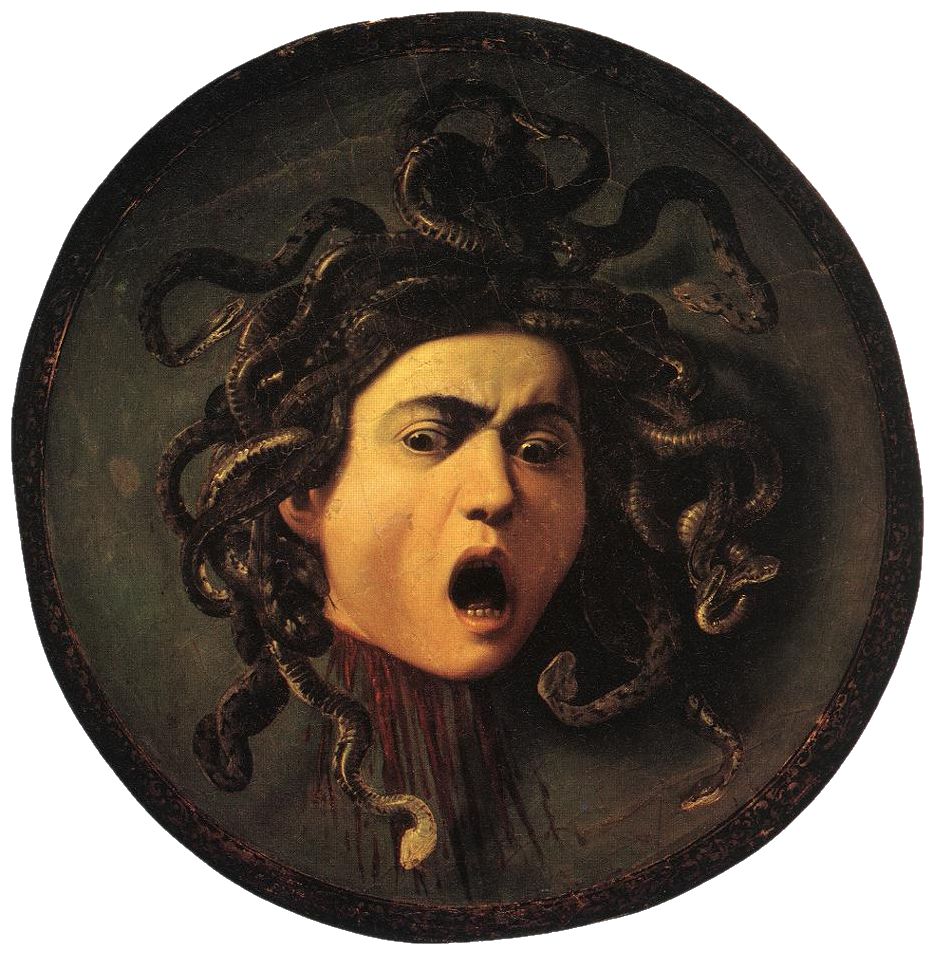
But back to our sheep, the system of Handicaps and Penalties outlined here is an interesting guideline, although I must confess, I'm pretty prone to shoving tiny magical quirks on virtually any magical item that my player's get their grubby hands on. This helps reinforce the idea that magic is unpredictable, and honestly, no two plus two swords should really be identical. The Handicaps associated with artifacts look pretty brutal, but the Penalty-per-use seems like a pretty way to balance an effectively limit-less spell casting item. I think in most cases, owning the artifact is enough of a problem as it is, and in the case of the Mask of Bachraeus, the players would probably have to contend with a rather perturbed nest of Medusae1, eager to get their precious artifact back.
ars ludi recently touched on making treasure special, and the artifact creation rules within the RC definitely seem to encourage this. By tying an epic history to an artifact, you can subtly encourage higher-level players to follow up on all those wonderful plot hooks and ideas that you've been itching to try out. In fact on the page there’s this lovely tidbit:
This artifact will shatter irrevocably if its gaze is ever reflected by the Golden Mirror of Ka. The wearer of the mask will be immediately stunned for a full turn and will remember nothing of what he did while wearing the mask, but he will be otherwise unharmed.Aspiring DMs are given a springboard for the creation of their first artifact, within the description of the sample artifact! Golden Mirror of Ka you say? The one that was lost when Milenia was sacked and razed by the Bogdashkan Orcs?
Anyone care to take a crack at stat-ing the Golden Mirror of Ka in the comments? If you do, feel free to also provide a page number of the RC for me to tackle next!
1. Medusae need a collective noun. In searching for a suitably snake-y noun, I did come across a rhumba of rattlesnakes, which is great.
Subscribe to:
Posts (Atom)